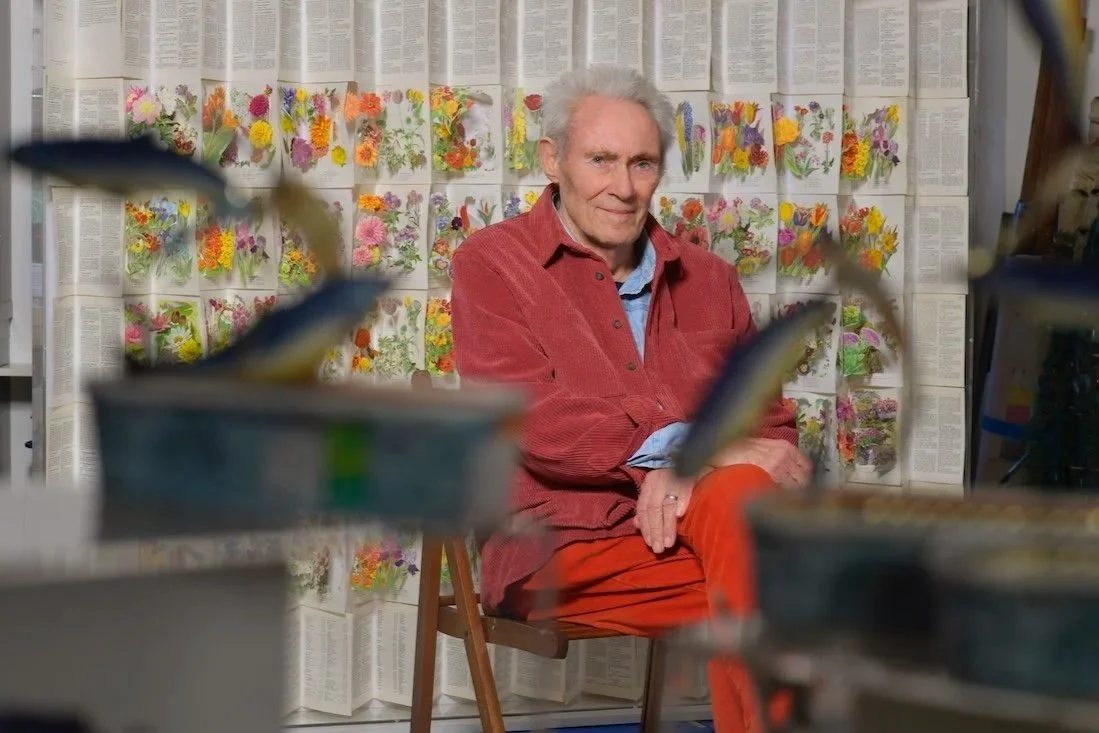
Jack Milroy in his studio surrounded by his 3D cut paper sculptures, 2026
About jack milroy
Contemporary British artist | 3D cut-paper sculpture & book-works
William “Jack” Milroy is a contemporary British artist whose intricate cut-paper constructions and sculptural book-works have defined a practice spanning more than six decades.
Born in Glasgow in 1938, he began his art education in his adopted county of Yorkshire at Scarborough School of Art (1956–60) before continuing his education at the University of London (1960–61). He later taught at West Surrey College of Art and Design in Farnham, influencing generations of young artists while maintaining an active presence within the London art world from the 1970s onwards.
Milroy moved away from painting relatively early in his career, turning instead to collage and sculpture. He is best known for his intricate three-dimensional cut-paper constructions and book-works, in which he transforms printed materials into complex architectural forms inspired by the Surrealists, Picasso, and Max Ernst. Through the processes of cutting, layering and reconstruction, he creates vast imagined worlds that range from cataclysmic visions to paradisal landscapes. His work combines precision and structural rigour, with a distinctive visual intelligence, poetic invention and a darkly playful sense of humour. While his earlier works often carried strong political undertones, his more recent pieces return to more joyful themes that explore the poetry within images.
Milroy has exhibited widely in the UK and internationally. Solo shows include Hester van Royen Gallery (1977), Glen Hanson Gallery, Minneapolis (1979), Scarborough Art Gallery (1987), Stephen Lacey (1999), alongside over 30 collaborations with Art First in London and recent exhibitions of new work such as Post-Card Post-Book at Benjamin Rhodes Arts (2025). Notable group shows include The British Art Show, organised by the Arts Council (1980), The Discerning Eye at the Mall Galleries (1999) and Catalyst at the Imperial War Museum North (2013). His forthcoming exhibition will be held at Shapero Modern, London, in April 2026.
Milroy’s work is held in the V&A, Imperial War Museum, the British Library, the UK Government Collection and several hospitals including Great Ormond Street. Internationally, his work is represented in collections including the Kit Kemp Collection and the Caldic Collection in the Netherlands. His works can also be found in numerous private and corporate collections here and abroad including British Airways HQ, De Beers, Chase Manhattan Bank, Fidelity, Bank of America, Nat West, Firmdale Hotels, University of Wisconsin, and Queen Mary University, London.
“Carved into dynamic life by his scalpel, his animals and plants leap, fly, float, swing across his glass cabinets subverting their encyclopaedic sources to propose questions about the nature of representation, perception and geopolitical reality.”
“Milroy specialises in making three-dimensinal objects using the potential hidden in two-dimensional images: delicate scalpel work makes a crowded aviary of an ornithological field guide, and botanical books blossom into life when their illustrations are cut and folded to burst from between their pages like so many posies. ”
“Jack Milroy doesn’t want to be categorised, either as a Surrealist or some kind of book artist. Nor does he think of himself as a sculptor…In fact, Milroy’s work resists all isms and plunges to the heart of the unclassifiable. He is resolutely independent and original.””
“The scalpel, with which Milroy carries out much of his work, is not just an instrument for the cutting of flesh, but an instrument of healing.”
“Jack Milroy’s art is made of visual puns and disturbances. He releases things with a scalpel and contains them again neatly in glass and perspex. This is a world put together by bricolage and happenstance— ephemeral as cardboard and paper — but full of thought and visual curiosity.”
“What he does is what he has always done, which is to take an object of some acquired resonance of meaning.....and to seek to give that resonance some concrete form as it were to release the image from the object.... The Milroy process is not to paint it, or copy it, or remake it, but rather to redeploy it, modify it by the most judicious of tweaks and fold, and recast it in a fresh perceptual light.”
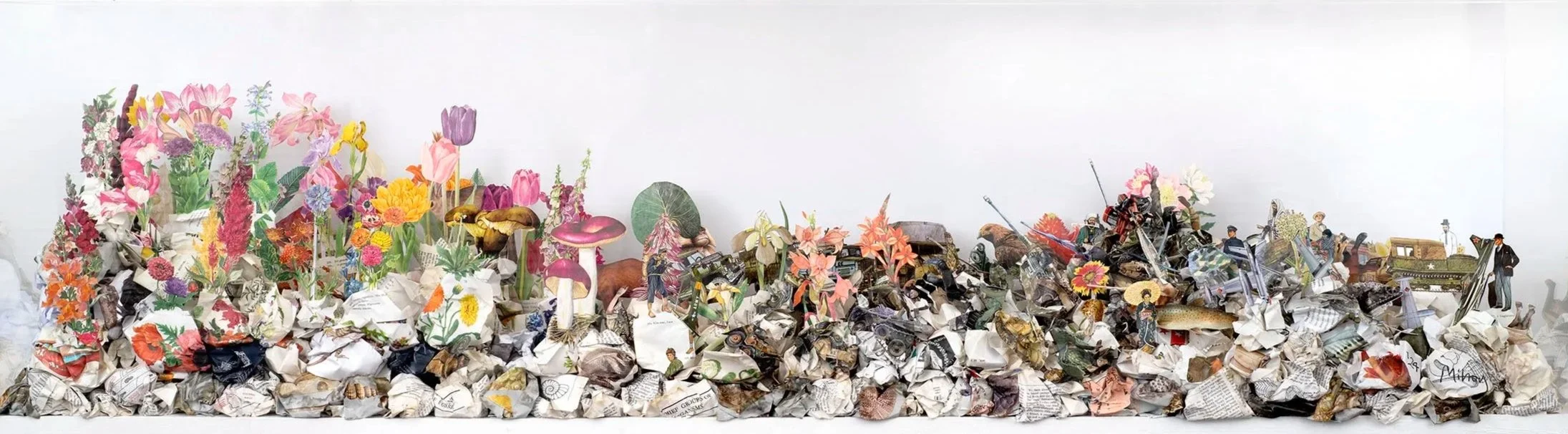
Monkey, 2024: one of Jack’s 3D cut-out paperworks
in his own words
Artists are for the most part notoriously reluctant to describe or explain, most of all to seek to justify, their own work. There are of course notable exceptions. Van Gogh and Delacroix spring immediately to mind, but even they fall into exceptional categories: the one of the intimate correspondence with a close friend, a colleague or, in this case, a brother; the other of the private notebook and journal, as it were the running conversation with oneself, or one’s peers. It is such essential intimacy that offers perhaps the clue, and reinforces the distinction: always the self-conscious, self-important public statement that is to be taken as suspect, and treated with studied care.
For the far from fanciful terror of the artist is that, by seeking to explain it, is at once to admit to inadequacy in the work to justify itself, and to constrain the work, and all its processes, to a specific programme and reading, thereby stripping it of all the excitement of uncertainty and intuitive discovery, and, most of all, its mystery. In short, to be so self-conscious is to cease to be an artist.
But the world at large is hungry for explanation and circumstantial detail, for why else would there be the critic, the curator, the journalist, the art historian, to offer a guiding hand, reassure, and get it wrong. And so it is we trap the artist into the more formal conversation of the interview, and hope our questions, on intentions, ideas, influences, meanings, will bring forth an ordered philosophy and ultimate enlightenment. The artist, on the other hand, is used to this by now, and will either play the philosophical game to leave us none the wiser – vide Francis Bacon stringing David Sylvester along – or fence such questions off with practicalities, principles and techniques, to the same effect. So the great comedy continues.
Jack Milroy, 2016

Detail from The Librarian’s Cottage Garden, 2026